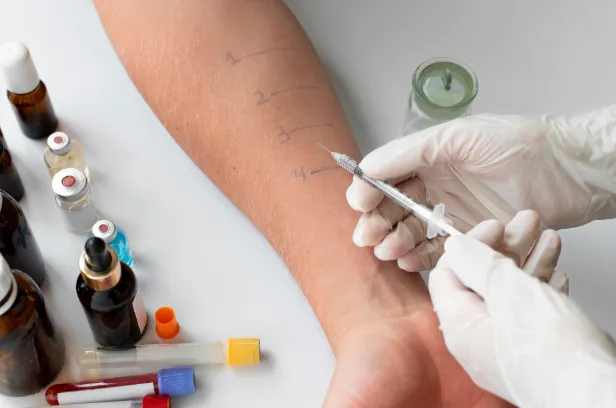
Mantoux Test
 Blood Sample
 Free Home Collection
 Digital Smart Report
 Recommended for Male/Female
 NABL & CAP Certified Labs
 Trusted by Leading Doctors & Organizations
About Mantoux Test: Booking, Price, and Results
| Field | Value |
|---|---|
| Also Known As | Tuberculin Skin Test (TST), PPD Test, Tuberculin Sensitivity Test, Mendel Mantoux Test |
| Sample Type | Intradermal injection (purified protein derivative injected into the inner forearm) |
| Fasting Required | No fasting required |
| Report Time | 48 to 72 hours (a second visit is required to read the result) |
| Recommended For | All ages, including infants and children; preferred for children under 5 years |
| Price | Starting at ₹150 |
What Is a Mantoux Test?
The Mantoux test is a skin test used to check whether a person has ever been exposed to the bacteria that cause tuberculosis (TB). A small amount of a substance called purified protein derivative (PPD) is injected just under the skin of the forearm, and the body's immune response is measured after 48 to 72 hours. Also called the tuberculin skin test or PPD test, it is commonly ordered by doctors when TB exposure is suspected or when screening is needed for high-risk individuals.
What Does a Mantoux Test Measure?
The tuberculin skin test measures a specific type of immune reaction called delayed-type hypersensitivity. When TB bacteria have previously entered the body, the immune system recognises the PPD antigen and produces a localised skin response.
The result is assessed by measuring the induration (a firm, raised swelling) at the injection site. Redness alone is not counted.
| What Is Measured | Why It Matters |
|---|---|
| Induration diameter (in mm) | Indicates whether the immune system has encountered TB bacteria before |
| Delayed immune response (Type IV reaction) | Confirms that T cells have been sensitised to TB antigens |
Why Is a Mantoux Test Done?
Doctors prescribe the Mantoux test when there is reason to suspect TB exposure or infection, or as part of routine screening in high-risk settings.
Common Symptoms That May Require This Test
The following symptoms commonly prompt a doctor to order a tuberculosis skin test:
- Persistent cough lasting more than two weeks
- Chest pain
- Coughing up blood or sputum
- Unexplained weight loss
- Prolonged fatigue or weakness
- Fever without a clear cause
- Night sweats
Conditions This Test Can Help Detect
The Mantoux test is used to identify the following conditions:
- Exposure to Mycobacterium tuberculosis, the bacteria that causes TB
- Latent TB infection, where bacteria are present in the body but cause no symptoms and are not contagious
- Need for further investigation when active TB disease is suspected (additional tests such as chest X-ray and sputum analysis are always required to confirm active infection)
How to Prepare and What to Expect
No special preparation is needed for the Mantoux test, but a few practical steps will help ensure accurate results.
Do You Need to Fast?
No, fasting is not required. You can eat and drink normally before and after the test. However, always follow the instructions given by your doctor or the diagnostic centre at the time of booking.
Practical Tips Before Your Test
Keep the following points in mind before you go for your tuberculin skin test:
- Inform your doctor if you have recently received a live virus vaccine (such as MMR or varicella). The test should be done on the same day as vaccination, or at least one month after.
- Tell your doctor if you have had a previous positive Mantoux result, have had a BCG vaccination, or are taking immunosuppressive medicines.
- Wear loose-fitting clothing that provides easy access to your forearm.
- Do not apply lotions or creams to the forearm before the test.
Step-by-Step Procedure
Here is what happens during the test and the follow-up visit:
- A trained healthcare professional cleans the inner surface of your forearm.
- A very small amount of PPD solution (0.1 mL containing 5 tuberculin units) is injected just beneath the top layer of the skin using a fine needle.
- A small, raised bump called a wheal (roughly 6 to 10 mm wide) appears at the injection site. This is normal and expected.
- You will be asked to keep the area clean and dry. Do not scratch, rub, or apply lotions or bandages to the site.
- You must return to the clinic or collection centre within 48 to 72 hours for the result to be read. Results read after 72 hours are considered unreliable.
- At the follow-up visit, the healthcare professional inspects the site under good light and measures the firmness (induration) of the skin in millimetres.
- The measurement is recorded as a number in millimetres, not simply as positive or negative.
Factors That Can Affect Accuracy
Several factors can influence your result. Let your doctor know if any of the following apply to you:
- Prior BCG vaccination (may lead to a false-positive result)
- HIV infection or use of immunosuppressive medicines (may cause a false-negative result)
- Severe malnutrition, chronic kidney disease, or recent surgery
- Recent TB infection within 8 weeks of testing (the immune response may not yet be detectable)
- Concurrent infections, lymphoma, or sarcoidosis
Understanding Your Mantoux Test Results
Your doctor will review the result alongside your medical history, risk factors, and any other tests ordered. The measurement in millimetres determines whether the result is considered positive, and the threshold varies depending on your risk level.
| Risk Category | Positive Result if Induration Is | Who This Applies To |
|---|---|---|
| High risk | 5 mm or more | People with HIV, recent TB contacts, organ transplant recipients, and those on immunosuppressive therapy |
| Moderate risk | 10 mm or more | People with diabetes, chronic kidney disease, or malnutrition; residents or staff of prisons, hospitals, or nursing homes |
| Low risk | 15 mm or more | General population with no known TB risk factors |
These ranges are general guidelines. Your doctor will interpret your results based on your age, health history, and other factors. Always consult a qualified healthcare professional for personalised medical advice.
Results During Special Conditions
Certain conditions can affect the reliability of your Mantoux test result:
- BCG vaccination can cause a false-positive reaction. This effect generally fades over time, typically reducing after 15 years, but may be prolonged by repeated testing.
- Immunosuppression (from HIV, medications, or serious illness) can suppress the immune response and produce a false-negative result even when TB infection is present.
- Protein malnutrition may reduce the body's ability to mount an immune response to TB, leading to a false-negative result.
How to Maintain Healthy Levels
While the Mantoux test is a diagnostic tool rather than a wellness measure, the following general habits support protection against TB:
- Ensure BCG vaccination, particularly in children, as it offers meaningful protection against severe forms of TB.
- Cover your mouth and nose when coughing or sneezing, and encourage those around you to do the same.
- Maintain a balanced diet and good general hygiene to support immune health.
Lupin Diagnostics Mantoux Test Price and Home Collection
The Mantoux test price at Lupin Diagnostics starts at ₹150, and home sample collection is available across cities. The following table shows approximate prices in selected Indian cities.
| City | Approximate Price (₹) |
|---|---|
| Chennai | ₹180 |
| Mumbai | ₹220 |
| Bengaluru | ₹150 |
| Kolkata | ₹220 |
| Hyderabad | ₹180 |
| Pune | ₹220 |
Prices are indicative and may vary by location. Please confirm the current price at the time of booking.
How to Book
Follow these steps to book your Mantoux test with Lupin Diagnostics:
- Select the test on the Lupin Diagnostics website.
- Choose your city and preferred time slot.
- Opt for home sample collection by a certified phlebotomist, or visit your nearest Lupin Diagnostics centre.
- Receive your report via email or WhatsApp within the stipulated turnaround time.
Home Collection
Lupin Diagnostics offers home collection for the Mantoux test near me across multiple cities in India. All samples are processed at NABL-accredited laboratories staffed by experienced technologists. Your digital report is delivered directly via email or WhatsApp once the reading visit is complete.
FAQs on Mantoux Test
The Mantoux test is used to determine whether a person has been exposed to TB bacteria. It can detect latent TB infection (where bacteria are present but cause no symptoms), but it cannot confirm active TB disease on its own. Additional tests are always needed for a complete diagnosis.
You must return to your healthcare provider within 48 to 72 hours of the injection. Results read after 72 hours are inaccurate because they underestimate the size of the skin reaction. If you miss this window, your doctor may recommend repeating the test.
Yes, prior BCG vaccination can cause a false-positive tuberculin skin test result. The effect typically decreases over time and is usually less significant more than 15 years after vaccination. Your doctor will take your vaccination history into account when interpreting your result.
Most people experience only mild discomfort during the injection, similar to any small skin prick. Some itching or mild swelling at the site is common and expected. Severe reactions are rare.
A positive result does not automatically mean you have active TB. Your doctor will likely order follow-up tests, such as a chest X-ray or a sputum culture, to determine whether the infection is latent or active. Consult your doctor promptly for the appropriate next steps.
Not always. People with HIV, those on immunosuppressive treatment, or those with severe illness may have false-negative results because their immune system cannot mount a detectable response to the PPD antigen. Your doctor may recommend alternative tests in such cases.
Mild itching, swelling, or irritation at the injection site is common and usually resolves on its own. Severe reactions are rare but may include heavy blistering or significant swelling. Do not scratch or rub the injection site, and keep the area clean and dry between your two visits.
Mantoux Test